

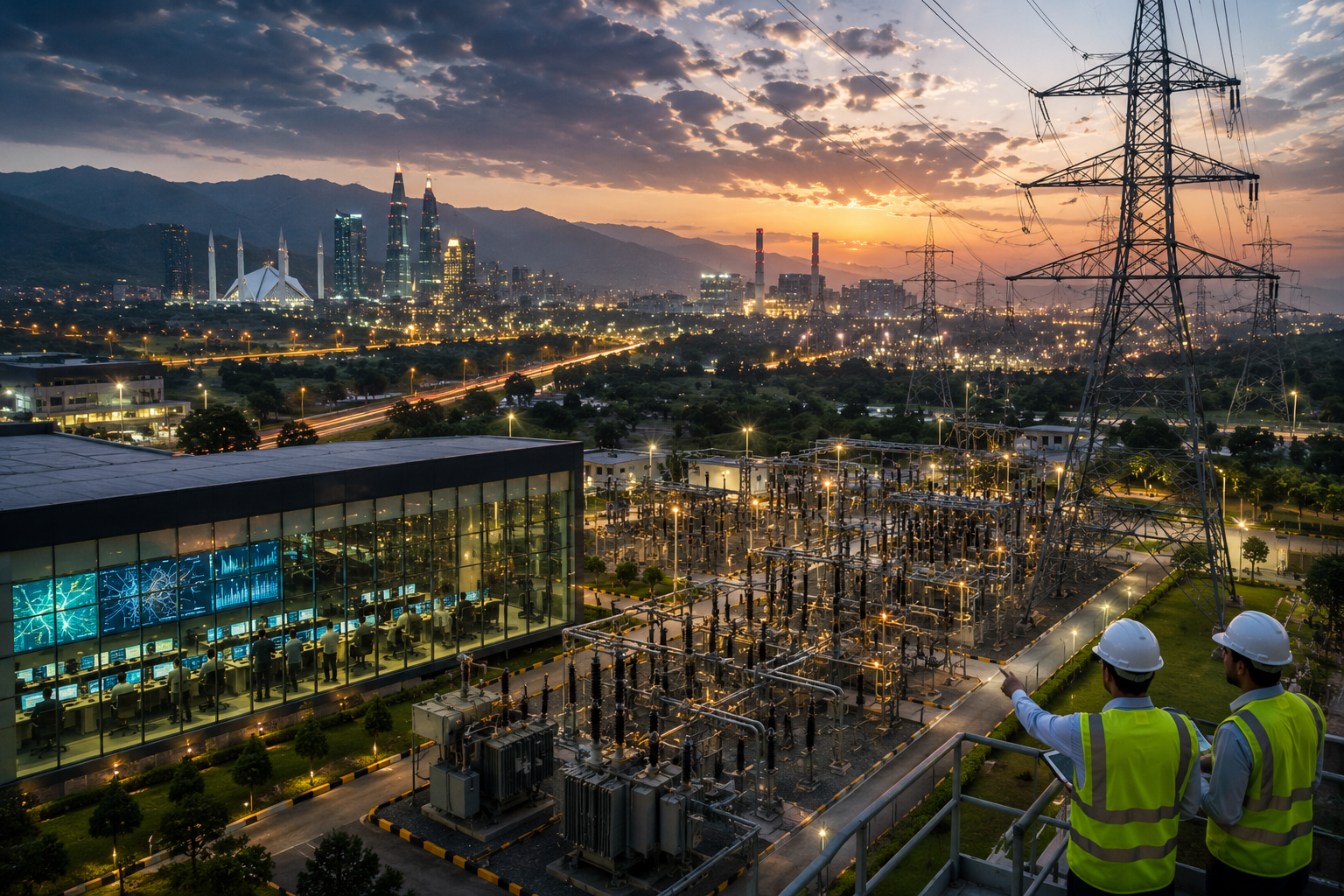
Pakistan is preparing for one of the most significant changes to its electricity sector in decades: transferring control of major state-owned power distribution companies to private investors.
The government’s first batch includes the Faisalabad Electric Supply Company (FESCO), Gujranwala Electric Power Company (GEPCO) and Islamabad Electric Supply Company (IESCO).
Investors are being offered between 51% and 100% ownership along with management control, potentially putting millions of electricity consumers under privately managed distribution networks.
The objective sounds straightforward: improve efficiency, modernize electricity distribution and provide better service.
But Pakistan’s power-sector problems run much deeper than ownership alone.
The real question is whether privatization can actually deliver cheaper, more reliable electricity—or simply replace public management with private management without solving the underlying problems.
Why Is Pakistan Privatizing DISCOs?
Pakistan’s electricity system has struggled for years with distribution losses, weak recoveries, ageing infrastructure, theft, inefficient management and mounting financial pressure.
These problems contribute to the wider financial difficulties of the power sector.
The government’s argument is that private operators have stronger incentives to reduce losses, invest in technology, improve billing and collections, modernize infrastructure and provide better customer service.
The Privatisation Commission says the process is intended to improve operational efficiency, reduce losses and create a more financially sustainable electricity-distribution system.
If successful, privatization could fundamentally change how electricity reaches Pakistani homes and businesses.
Investors Are Showing Serious Interest
The programme is no longer merely theoretical.
GEPCO attracted 11 expressions of interest from investors and consortia, including domestic and international participants.
The government has also conducted investor outreach in countries including Saudi Arabia, Türkiye and China.
FESCO has already moved through its initial expression-of-interest stage, while the current deadline for IESCO expressions of interest is September 7, 2026.
This level of investor interest is important because competition between credible bidders could improve the government’s chances of obtaining stronger valuations and experienced operators.
Why Start With FESCO, GEPCO and IESCO?
These three companies are among Pakistan’s more commercially attractive electricity distributors.
Together they serve more than 14 million consumers across major urban, industrial and commercial regions.
Starting with comparatively viable companies gives the government a better chance of demonstrating that privatization can work before tackling more difficult distribution networks.
It also creates a test.
If private ownership cannot significantly improve some of Pakistan’s stronger DISCOs, expectations for reforming weaker companies will inevitably come under pressure.
Privatization Alone Will Not Make Electricity Cheap
This is perhaps the most important distinction for consumers.
Privatization does not automatically mean lower electricity bills.
A distribution company represents only one part of the electricity supply chain.
The final cost consumers pay is influenced by electricity generation costs, fuel prices, capacity payments, transmission expenses, taxes, subsidies, regulatory decisions and distribution losses.
A private operator may become better at collecting bills and reducing electricity theft, but it cannot independently eliminate every cost built into Pakistan’s power system.
That means consumers should judge privatization on more than tariffs.
Fewer outages, faster complaint resolution, accurate billing, better infrastructure and reduced technical losses would also represent meaningful improvements.
What Happens to Existing Liabilities?
One of the biggest challenges is making these companies attractive enough for serious investors.
The government is therefore restructuring the first three DISCOs before their sale.
Under the proposed framework, a government-owned Special Purpose Vehicle (SPV) would hold selected assets and liabilities carved out of FESCO, GEPCO and IESCO.
The objective is to create commercially viable companies that private investors are willing to acquire.
But this raises an important public-policy question.
If problematic liabilities remain with the government while commercially attractive operations move to private investors, taxpayers need transparency about exactly what financial obligations the state retains.
Privatization should not merely transfer profitable assets while leaving the public responsible for accumulated financial problems.
Pakistan Already Has a Private-Sector Electricity Example
Pakistan does not need to look abroad to understand the complexity of private electricity distribution.
Karachi has long operated with a privately controlled electricity utility.
Its experience demonstrates that private management can introduce investment, technology and stronger commercial discipline—but privatization does not automatically eliminate public concerns surrounding tariffs, outages, regulation and customer service.
The lesson is not that privatization succeeds or fails by definition.
It is that regulation matters just as much as ownership.
A private electricity monopoly without effective regulation can create its own problems.
What Consumers Should Expect
For ordinary Pakistanis, the success of this programme should eventually be measurable.
Consumers should be able to ask simple questions.
Are outages becoming less frequent?
Are electricity bills becoming more accurate?
Are complaints being resolved faster?
Is electricity theft declining?
Are transformers and distribution networks being upgraded?
And most importantly, is the system becoming efficient enough to reduce the financial burden ultimately carried by consumers and taxpayers?
If the answers remain unchanged several years after privatization, simply changing ownership will have achieved little.
The Bigger Opportunity
Pakistan’s power sector is one of the country’s biggest barriers to industrial competitiveness.
Factories need predictable electricity.
Technology businesses need reliable infrastructure.
Exporters cannot compete internationally when energy is unreliable or excessively expensive.
Successful electricity reform could therefore have consequences far beyond household power bills.
It could improve Pakistan’s ability to attract factories, increase exports, generate employment and compete for international investment.
A Test of Pakistan’s Economic Reform
The sale of FESCO, GEPCO and IESCO will be watched closely because it represents something larger than three corporate transactions.
It is a test of whether Pakistan can successfully restructure major state-controlled enterprises, attract credible investors and protect consumers simultaneously.
Private-sector management may help reduce inefficiency and bring new investment into electricity distribution.
But privatization itself is not a magic solution.
Pakistan still needs strong regulation, transparent transactions, modern infrastructure, power-market reforms and accountability.
If those elements come together, privatization could become an important part of fixing electricity distribution.
If they do not, Pakistan may simply change who manages the problem rather than solving it.