

Pakistan’s electric-vehicle market has another serious contender.
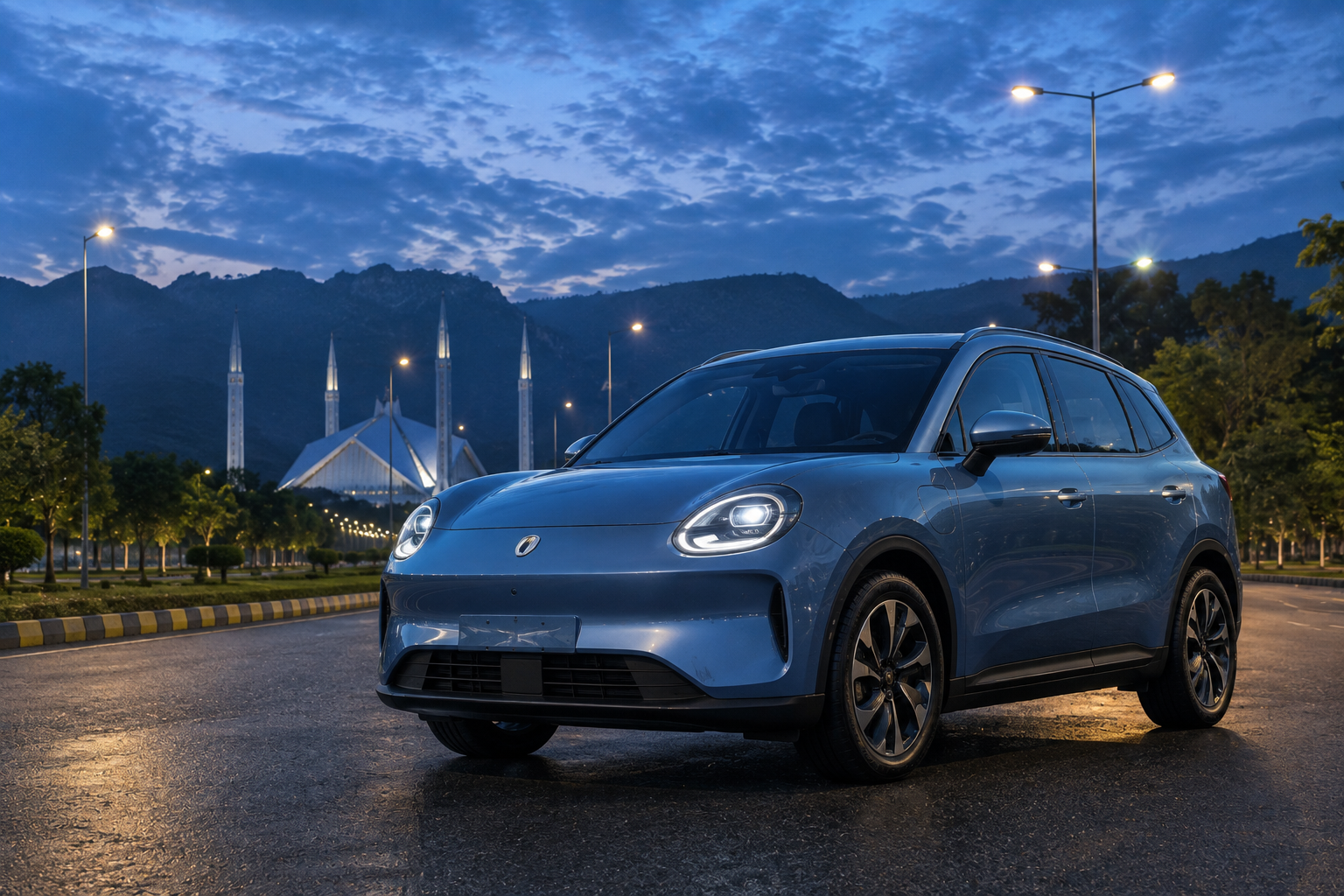
GWM has officially introduced the ORA 5 in Pakistan through Sazgar, positioning the fully electric model in one of the most competitive areas of the country’s rapidly changing automobile market.
Priced at Rs8.599 million ex-factory, the ORA 5 arrives at a point when Pakistani buyers have more electrified choices than ever before.
But its real challenge is bigger than competing with another EV.
Can a vehicle like the ORA 5 convince traditional petrol-crossover buyers that it is finally time to go electric?
A 430km-Plus Electric Car
At the heart of the ORA 5 is a 58.33kWh lithium iron phosphate battery paired with a front-mounted electric motor.
The motor produces 150kW of power and 260Nm of torque, while the locally listed specification gives the vehicle a driving range of up to 430km under the WLTC cycle.
It can accelerate from 0–100km/h in around eight seconds and has a claimed top speed of 170km/h.
Those figures put the ORA 5 well beyond the idea of an EV designed only for short urban journeys.
For many owners, a range above 400km could make daily charging unnecessary.
More Than a Small Electric Hatchback
The ORA 5 also occupies an interesting position in terms of size.
At 4,471mm long and 1,833mm wide, with a 2,720mm wheelbase, it has dimensions that give it significantly more road presence than a conventional Pakistani hatchback.
It rides on 18-inch alloy wheels and offers 175mm of ground clearance.
That matters in Pakistan, where buyers increasingly favour crossover-style vehicles for their space, road presence and practicality.
Instead of asking consumers to abandon everything they like about crossovers in order to buy an EV, the ORA 5 attempts to combine those qualities with an electric powertrain.
Technology Is Part of the Attraction
Electric cars increasingly compete on software and technology as much as traditional mechanical specifications.
The ORA 5 comes with a range of modern comfort and safety features.
Available equipment includes a panoramic glass roof, electrically adjustable front seats, an electric tailgate and advanced driver-assistance systems.
Safety technology includes features designed to warn or intervene in situations involving potential forward, rear and cross-traffic collisions.
There is also a camera-based system designed to detect driver fatigue and distraction.
These features are important because Pakistani consumers spending close to Rs9 million increasingly expect far more than basic transportation.
The Rs8.599 Million Question
Price will ultimately determine how seriously Pakistani consumers consider the ORA 5.
At Rs8.599 million, it is not an inexpensive vehicle.
However, it sits in a market where conventional petrol and hybrid crossovers have also become expensive.
That changes the calculation.
An EV no longer needs to compete with a Rs3 million petrol car to become relevant. It needs to offer enough value against similarly priced crossovers.
For buyers with home charging, electricity costs could make daily running considerably different from operating a petrol vehicle.
Electric motors also have fewer conventional drivetrain components requiring routine maintenance.
But the initial purchase price remains substantial, and resale value will be an important consideration for Pakistani buyers.
Charging Remains the Biggest Question
Range is only one part of EV ownership.
Charging infrastructure remains critical.
The ORA 5 supports a 6.6kW AC onboard charger, making overnight home charging an important part of its ownership proposition.
For people living in houses with dedicated parking, installing a home charger can make an EV remarkably convenient.
The situation is more complicated for people living in apartments or locations without reliable access to private charging.
Pakistan’s public charging network is expanding, but it still cannot match the convenience and availability of petrol stations.
Until charging becomes easier across cities and highways, this will remain one of the biggest obstacles preventing EVs from becoming truly mainstream.
Pakistan’s Electricity Question
EV adoption in Pakistan also creates an unusual debate.
Pakistan has historically struggled with electricity costs and power-sector challenges.
So why shift transportation toward electricity?
The answer lies partly in efficiency and energy diversification.
Electric vehicles can be charged from an electricity system that increasingly incorporates solar and other domestic energy sources, while petrol vehicles remain dependent on liquid fuels.
Pakistan has witnessed enormous growth in rooftop solar installations, which could make EV ownership particularly attractive for households already generating part of their own electricity.
For such consumers, an electric car can become part of a larger household-energy ecosystem rather than simply another vehicle.
Competition Is Getting Serious
The ORA 5 is not entering an empty market.
Pakistan’s EV segment is becoming increasingly crowded as Chinese manufacturers introduce electric vehicles at different price points.
At its price, one of the ORA 5’s most obvious competitors is the BYD Atto 3, although the two vehicles differ in positioning and body style.
This growing competition is good news for consumers.
More brands mean greater pressure on manufacturers to improve pricing, warranties, charging support, features and after-sales service.
The EV market in Pakistan is therefore beginning to move beyond novelty.
It is becoming a genuine automotive segment.
Can the ORA 5 Go Mainstream?
The ORA 5 has several ingredients required to make electric vehicles more attractive in Pakistan.
It offers more than 400km of claimed driving range, strong performance, modern safety technology and dimensions suitable for everyday family use.
Its biggest obstacle may not be the vehicle itself.
It is the ecosystem around it.
Charging infrastructure, resale confidence, battery perceptions, financing and long-term after-sales support will determine whether Pakistani buyers are willing to leave petrol behind.
At Rs8.599 million, the ORA 5 will not make electric mobility accessible to every Pakistani household.
But mainstream adoption does not happen overnight.
It happens when electric vehicles stop being viewed as experiments and begin competing directly with conventional cars on price, practicality and ownership experience.
The ORA 5 is another sign that Pakistan may be approaching that point.
The question is no longer whether electric cars will become part of Pakistan’s automotive market.
It is how quickly Pakistani buyers will be ready to make the switch.