

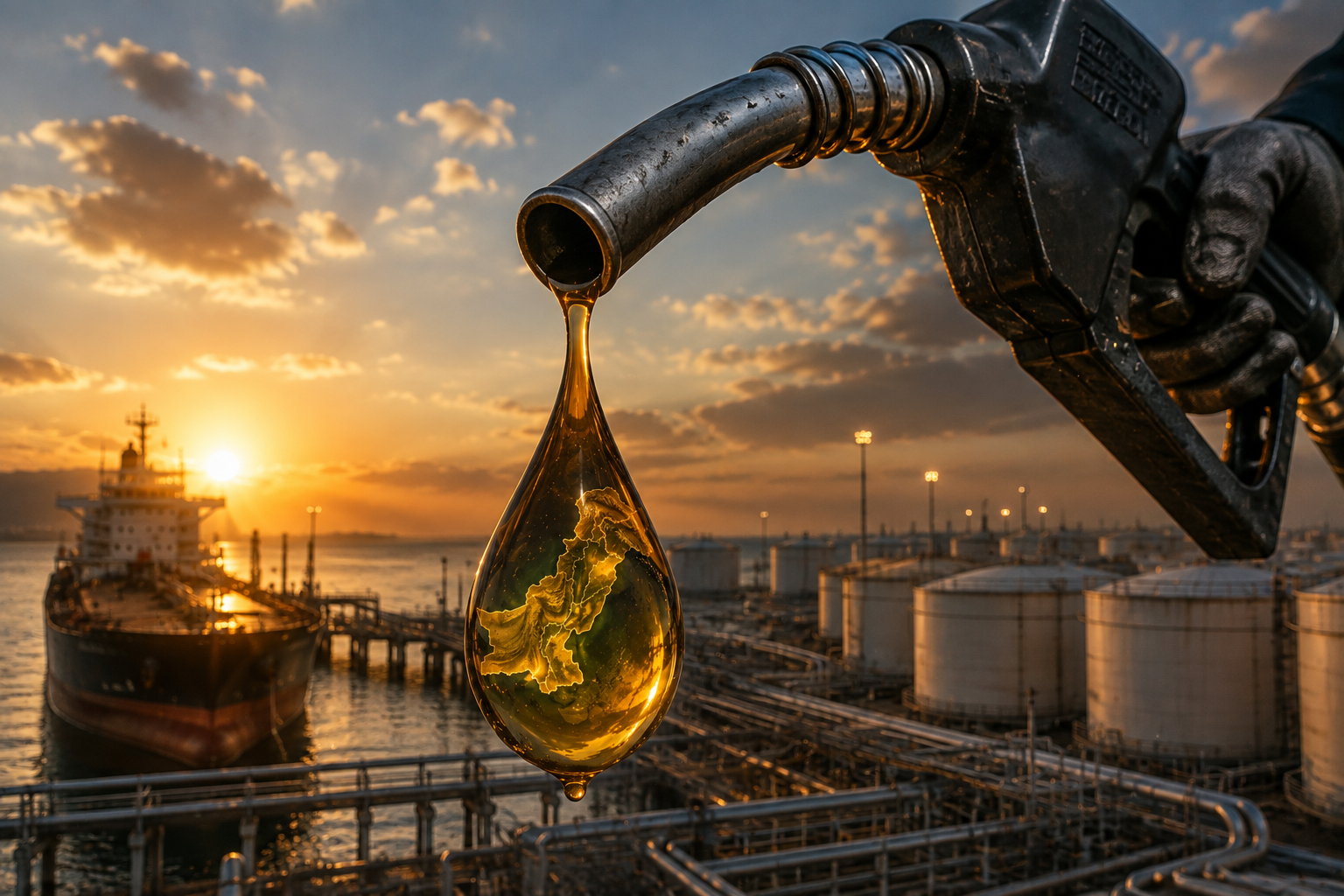
Pakistan is attempting to address one of the biggest vulnerabilities in its economy: what happens when the international oil supplies it depends on are suddenly disrupted?
The government is moving toward establishing Pakistan’s first major commercial bonded oil-storage system, potentially allowing Gulf producers and international commodity traders to keep petroleum products inside the country for local sale or onward export.
The proposal could give Pakistan something it currently lacks during an international energy emergency—a substantial fuel buffer already sitting inside its borders.
For a country heavily dependent on imported energy, that could become strategically important.
Why Pakistan Needs an Energy Buffer
Pakistan’s dependence on international energy markets leaves the economy exposed to events it cannot control.
According to Petroleum Minister Ali Pervaiz Malik, Pakistan imports around 90% of its energy requirements, while domestic oil production is approximately 70,000 barrels per day against demand of roughly 500,000 barrels.
More importantly, Pakistan has historically depended heavily on oil and LNG shipments travelling through the Strait of Hormuz.
That vulnerability became impossible to ignore during the latest disruption in Gulf shipping.
A conflict thousands of kilometres from Pakistani cities can therefore affect fuel availability, transportation costs, electricity generation, inflation and the country’s import bill.
The government’s new strategy is designed partly to reduce that risk.
How Would Bonded Oil Storage Work?
The concept is relatively straightforward.
Foreign energy companies could bring petroleum products into Pakistan and store them in designated customs-bonded facilities.
Crucially, the fuel would continue to belong to the foreign supplier.
Because it would remain in bonded storage, it would not immediately be treated like a conventional Pakistani import. The supplier could later sell it to Pakistani companies or re-export it to another international market.
That could make Pakistan more attractive as a regional energy-storage and distribution location.
But there is another important component.
During an emergency, Pakistan would have the opportunity to purchase certain stocks already stored inside the country.
Instead of waiting for a tanker to travel thousands of kilometres during a supply crisis, Pakistani companies could potentially obtain fuel already sitting at domestic storage facilities.
Saudi Arabia, Kuwait and Qatar Could Play a Major Role
The government’s ambitions involve some of the Gulf’s biggest energy producers.
Petroleum Minister Ali Pervaiz Malik has said Pakistan has been working with Saudi Arabia, Kuwait and Qatar on the proposed bonded-storage arrangement.
The scheme has also been developed following consultations involving major energy companies.
The attraction for Gulf producers is commercial.
Pakistan sits beside the Arabian Sea and close to some of the world’s most important energy and shipping routes. Storage facilities in Pakistan could potentially serve domestic consumers while also supporting exports to other markets.
For Pakistan, the attraction is energy security.
Foreign suppliers would finance and own the petroleum inventory while Pakistan could gain greater physical access to fuel during periods of disruption.
Why Not Simply Build Pakistan’s Own Strategic Oil Reserve?
That is another option—and one the government is also examining.
But strategic petroleum reserves are expensive.
The petroleum minister has estimated that maintaining approximately one month of crude-oil reserves could require around $500 million, while developing underground storage infrastructure could require another $300 million to $400 million.
For a government facing tight fiscal constraints, those are significant amounts.
Commercial bonded storage offers a different model.
Instead of Pakistan purchasing every barrel itself and paying to keep it in storage, international suppliers could maintain commercially owned inventories inside the country.
That does not completely replace the need for strategic national reserves.
But it could provide another layer of protection.
Pakistan Could Become More Than an Oil Buyer
There is also a larger economic opportunity.
Pakistan traditionally approaches energy security from the perspective of an importer: the country needs oil, therefore it purchases oil from somewhere else.
A successful storage system could begin changing that relationship.
Pakistan could potentially become a regional storage, trading and distribution hub.
Oil arriving from Gulf producers could be stored at Pakistani terminals, sold domestically when needed or shipped onward to other markets.
That could generate investment in ports, pipelines, terminals, logistics and storage infrastructure.
Pakistan’s geographic location could therefore become a commercial asset rather than simply an energy vulnerability.
The Strait of Hormuz Changed the Conversation
The urgency behind these plans is not difficult to understand.
Recent disruption around the Strait of Hormuz has demonstrated how quickly geopolitical conflict can become an economic emergency.
Pakistan’s reliance on Gulf supplies means serious disruption to the waterway can threaten far more than petrol stations.
Diesel powers transportation and agriculture.
Jet fuel affects aviation.
Petroleum products feed industries.
LNG supports electricity generation.
And rising international energy prices increase Pakistan’s import bill and put pressure on foreign-exchange reserves.
Fuel security is therefore also economic security.
Diversifying Where Pakistan Buys Oil
Storage is only one part of the strategy.
Pakistan is also trying to diversify its energy supplies.
Pakistani refiner Cnergyico has been increasing imports of American crude as Gulf disruptions expose the risks of depending too heavily on one region.
The company imported around 8.1 million barrels of U.S. crude over nine months, according to Reuters.
Diversification matters because energy security is strongest when a country has multiple suppliers, multiple shipping routes and sufficient domestic storage.
Depending on one supplier is risky.
Depending on one maritime chokepoint can be even riskier.
The Challenges Are Significant
The bonded-storage system will still need to overcome regulatory and commercial hurdles.
One important issue involves taxation.
Foreign companies need clarity about whether storing fuel in Pakistan will create local tax obligations before that fuel is actually sold into the Pakistani market.
The petroleum ministry’s proposed framework would allow foreign suppliers to keep products in bonded storage without immediately entering Pakistan’s tax system, while applicable taxes would be paid when petroleum products are cleared for domestic consumption.
Clear rules will be essential.
Global energy companies will not place large inventories inside Pakistan unless they are confident about taxation, regulation, security and their ability to move products efficiently.
Storage Alone Will Not Solve Pakistan’s Energy Problem
Pakistan should also avoid treating bonded storage as a complete solution.
Having more fuel available during emergencies can improve resilience, but it does not eliminate the country’s underlying dependence on imported energy.
Long-term energy security will require several strategies working simultaneously.
Pakistan needs greater domestic oil and gas exploration, refinery modernization, renewable-energy investment, efficient electricity generation and stronger energy infrastructure.
It also needs to reduce waste and improve the financial sustainability of the energy sector.
Storage buys time during a crisis.
Domestic energy capacity reduces the likelihood that the crisis becomes overwhelming.
Turning Geography Into an Economic Advantage
Pakistan occupies an important geographic position between the Gulf, South Asia, Central Asia and major Indian Ocean shipping routes.
For decades, policymakers have spoken about converting that geography into economic opportunity.
Energy infrastructure could provide one practical way of doing it.
If Gulf producers begin storing petroleum products in Pakistan, and if those facilities eventually connect efficiently with ports, pipelines, refineries and international markets, Pakistan could develop a larger role in regional energy trade.
The immediate objective, however, is simpler.
When the next international oil shock arrives, Pakistan wants more options than waiting for another tanker.
The bonded-storage strategy will not make the country energy independent.
But combined with strategic reserves, diversified imports, domestic exploration and refinery upgrades, it could make Pakistan considerably harder to disrupt.
And after the vulnerabilities exposed by the Strait of Hormuz crisis, that resilience may be worth almost as much as the fuel itself.