

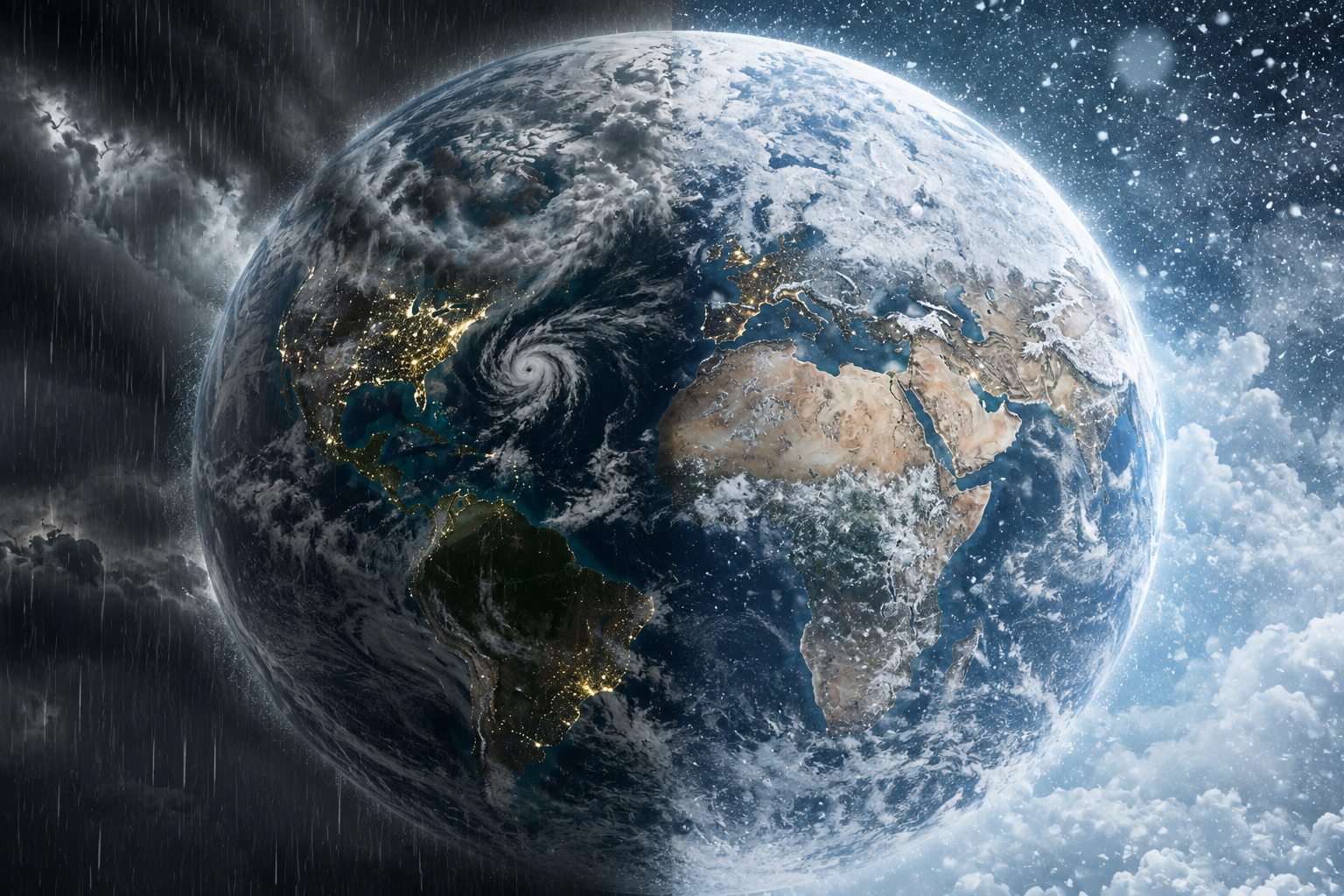
For decades, climate change was largely discussed as an environmental problem: rising temperatures, melting glaciers, extreme weather and rising seas.
But a much bigger transformation is now becoming visible.
Climate change is beginning to alter the economic and strategic geography of the planet. Shipping routes that powered global trade for generations are facing new pressures, while previously difficult passages through the Arctic are attracting growing commercial and geopolitical interest.
In other words, climate change is not physically redrawing national borders overnight—but it is changing which locations, waterways and countries matter most to the global economy.
The Arctic Is Becoming a New Strategic Frontier
One of the clearest examples can be found in the Arctic.
As Arctic sea ice declines, northern shipping routes are becoming increasingly accessible. These passages could offer alternatives to much longer traditional routes connecting Asia and Europe.
The change is already moving beyond theory.
In August 2026, a South Korean container ship embarked on the country’s first commercial voyage to Europe through an Arctic route. The journey is designed to test its commercial viability, while South Korea hopes Arctic shipping could eventually help strengthen Busan’s position as a major maritime hub.
Russia and China have also demonstrated significant strategic interest in Arctic transportation.
This means melting ice is creating an unusual geopolitical reality: an environmental crisis is simultaneously opening potential new commercial corridors.
Meanwhile, Traditional Trade Routes Face Climate Pressure
While opportunities emerge in the north, some of the world’s established shipping arteries are becoming more vulnerable.
The Panama Canal provides a powerful example.
Unlike the Suez Canal, Panama’s lock system requires enormous quantities of freshwater. When rainfall falls and reservoir levels decline, authorities have fewer resources available to move vessels between the Atlantic and Pacific.
That has real consequences for global commerce.
The Panama Canal Authority announced this month that it will restrict daily ship transits as the region prepares for severe El Niño conditions. Rainfall between May and August was reported to be 34% below average, while watershed inflows were 44% below normal.
It is a reminder that the infrastructure supporting globalisation was designed around climatic conditions that can no longer always be taken for granted.
Rivers Are Becoming Economic Chokepoints Too
The problem extends beyond oceans and canals.
Low water levels on major European rivers such as the Rhine and Danube have periodically restricted cargo transportation.
When river levels become too low, vessels may have to reduce their cargo loads or businesses must shift goods onto trucks and trains.
That increases transportation costs.
And those costs eventually move through supply chains—from factories and energy producers to supermarkets and consumers.
Climate change therefore has the potential to affect inflation without destroying a single factory.
It only needs to make moving goods more difficult.
Climate Change Could Shift Global Power
The geopolitical consequences may be even larger.
Countries controlling ports, shipping corridors, critical minerals, renewable-energy technology and resilient infrastructure could gain strategic importance.
China, for example, has developed enormous manufacturing capacity across electric vehicles, batteries, solar technology and other clean-energy industries while simultaneously expanding its maritime capabilities.
Meanwhile, Arctic nations are increasingly thinking about northern shipping, resources and security.
Climate policy is therefore becoming intertwined with industrial policy, trade policy and national security.
The countries that adapt fastest may gain advantages over those that treat climate change purely as an environmental issue.
Food Security Could Also Be Reshaped
Agriculture is another major vulnerability.
Extreme heat, drought, flooding and changing rainfall patterns can disrupt harvests across major food-producing regions.
If climate disruption occurs simultaneously in several important agricultural economies, the consequences can spread through international commodity markets.
Countries heavily dependent on imported wheat, edible oil, pulses or other food commodities can then experience higher prices even when their own farms have not suffered a disaster.
Climate change is consequently transforming food security from a domestic agricultural issue into an international strategic concern.
What This Means for Pakistan
Pakistan has particularly strong reasons to watch this transformation.
The country sits close to some of the world’s most important maritime trade and energy routes while simultaneously facing significant exposure to floods, extreme heat, water stress and changing weather patterns.
Pakistan’s ports at Karachi and Gwadar connect the country to the Arabian Sea, while its economy depends substantially on international trade and imported energy.
Changes in shipping costs, energy markets, agricultural production and global supply chains can therefore reach Pakistani consumers relatively quickly.
At the same time, Pakistan’s geographic position could become increasingly important as Asian, Middle Eastern and Central Asian trade patterns evolve.
The challenge is turning geography into economic advantage while building infrastructure resilient enough for a changing climate.
The Map Isn’t Changing—Its Value Is
The most important consequence of climate change may ultimately be something that conventional maps cannot show.
The continents will remain where they are.
But the economic value of particular ports, rivers, shipping lanes, agricultural regions and energy resources can change dramatically.
An Arctic passage that was once commercially unrealistic may become strategically important.
A canal that reliably handled international commerce may become vulnerable to drought.
A fertile agricultural region may face increasingly unpredictable harvests.
And countries once considered geographically peripheral may find themselves sitting beside the trade routes of the future.
Climate change is therefore doing more than warming the planet.
It is quietly changing the economic and geopolitical value of the world map.