

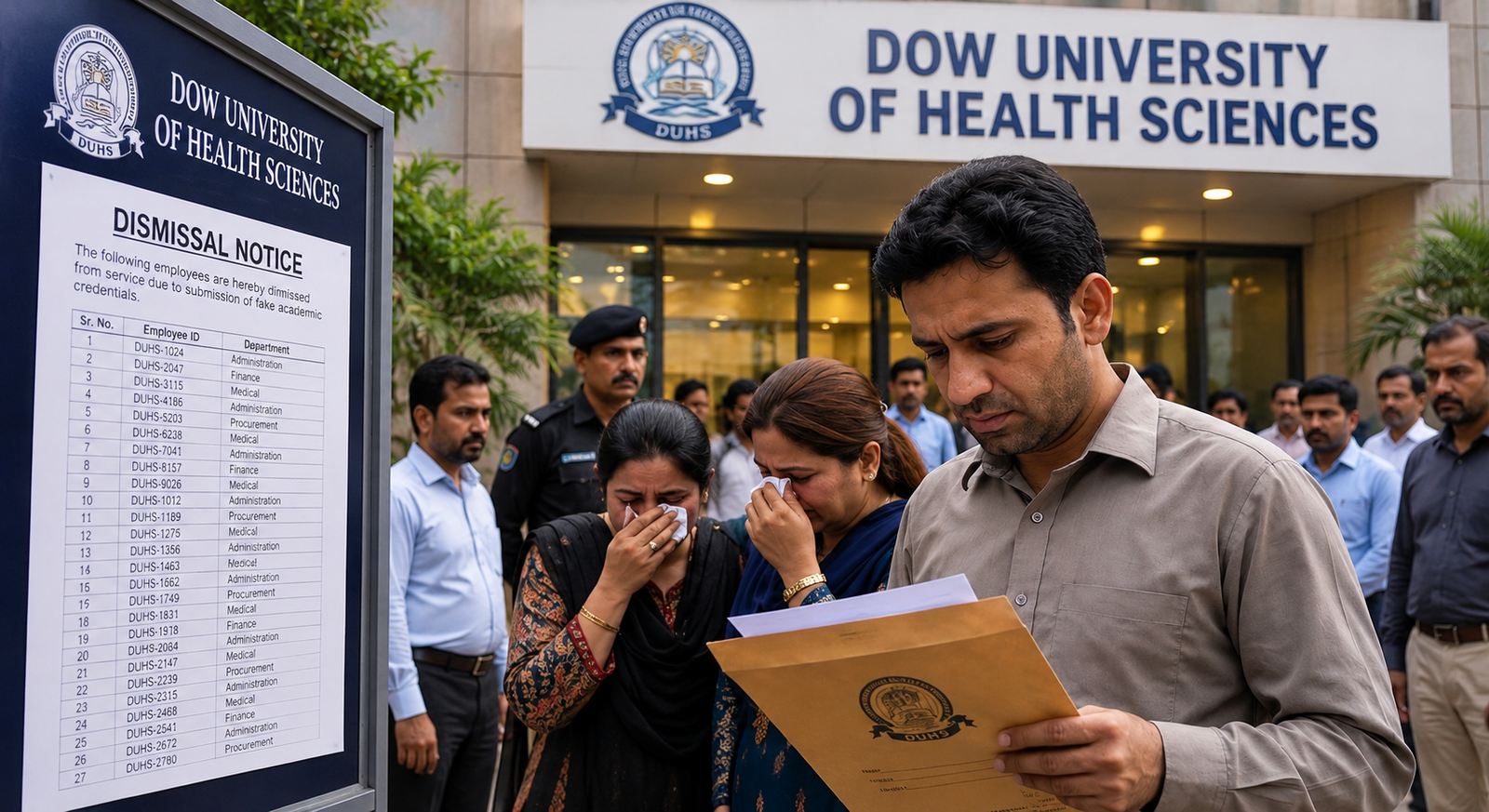
A major qualification-verification controversy has emerged at Dow University of Health Sciences (DUHS) in Karachi, raising concerns about recruitment standards and employee accountability.
Officials informed the Sindh Assembly’s Public Accounts Committee that 27 university employees had been dismissed after their academic credentials were found to be fake.
The development has renewed questions about how educational qualifications are checked before people enter important public-sector positions.
What Did the Investigation Reveal?
According to the information presented to the committee on October 20, Dow University has approximately 5,350 employees.
The academic credentials of around 1,945 employees had been verified, while verification of another 3,400 remained pending.
Among the employees whose records were checked, 27 were found to have fake educational documents.
The Public Accounts Committee, chaired by Nisar Ahmed Khuhro, directed the university to recover salaries paid to the dismissed employees.
The committee also sought information about qualification verification at other public universities in Sindh.
Why Are Fake Degrees a Serious Issue?
Educational qualifications are an important part of recruitment, especially in healthcare and academic institutions.
Employers use degrees to assess whether candidates meet the requirements of their positions.
When someone submits false educational credentials, it can weaken confidence in the recruitment process and disadvantage honest applicants.
However, it is important to distinguish employees with confirmed fake documents from those whose degrees are still awaiting verification.
The pending status of 3,400 employees does not mean those employees possess fake degrees.
What Should Institutions Learn?
The latest development highlights the need for better checks during recruitment.
Universities and other organisations can reduce risks by verifying qualifications directly with authorised institutions before confirming appointments.
Digital record systems, regular audits, and clear hiring procedures can also help improve transparency.
For job applicants, maintaining authentic educational records remains essential.
What Happens Now?
The Public Accounts Committee has requested broader verification information from Sindh’s public universities.
The coming months will show whether the latest action leads to stronger recruitment procedures across the province.
The real challenge is not only identifying fake qualifications but also building a system that prevents them from entering public institutions in the first place.